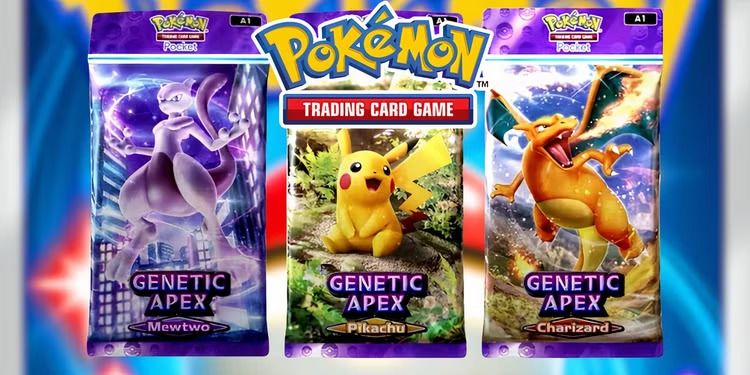
If you haven’t heard about TCG investing you’re not alone. I came across Trading Card Game investing through my brother, who has built a 5-figure portfolio buying and holding Pokémon cards.
It may sound a little silly at first, that is until you look at gains TCG investors are making from this.
I was a little reluctant to touch on the topic, but this is an investing blog after all.
After seeing my brother’s portfolio grow, it got me thinking that TCG investing might just be the next big money move of the decade.
The industry is expected to grow from its current $15 billion market valuation between $21 billion to nearly $34 billion by 2035.
The market is now heavily driven by adults and institutional collectors with disposable income, with the “adults” segment commanding nearly half of the entire TCG market share, according to Market.US.
These collectibles, which vary from Pokémon cards to One Piece, Yugioh, and of course sports cards, have become alternative investments for many “high net worth investors”, according to the CAIA Association.
Is it time to follow the money within TCG investing? That’s what we’re here to find out.
Let’s get started!
The Gains Don’t Lie
For a year now, my brother has dorked-out on me about investing in Pokémon cards, which I found a little humorous at first.
Then he showed me his portfolio, or at least a snippet of it.
TCG Investing Portfolio – FrankNez Media
From only one segment of his portfolio, he’s seen a gain of $2,231.12 in the past 30 days.
He has cards worth upwards of hundreds of dollars to a Mega Charizard valued at $1.43K in pristine condition.
There’s no doubt there is money in investing in trading card games. But how does it compare to investing in the stock market?
Markets go up and down, however, over the last 20 years, highly curated “vintage grails” have drastically outperformed the S&P 500.
However, the broader card market faces distinct traps that do not exist in traditional stock portfolios.
In the S&P 500 you can sell at market price instantly during trading hours.
In TCG investing, it can take days, weeks, or even months to find a buyer.
Fees are also higher with TCG. Platforms such as eBay or TCG Player take between 10% to 15% cuts while many modern brokerages have 0% to significantly smaller fees.
Both stocks and TCG face the possibility of dilution through further stock issuance or from reprint of older card sets, which can wipe out value overnight.
A massive benefit of TCG investing is how supply does organically go down.
Unlike stocks or crypto, the physical supply of vintage TCG assets shrinks organically over time.
Every year, a small percentage of older cards are permanently lost, damaged by water, or ruined by poor handling. This means that for out-of-print “vintage” items, supply moves in only one direction: down.
Should You Invest in TCG (Trading Card Game)?
Trading Card Game (TCG) investment.
The market continues to see robust liquidity, largely driven by a highly mature infrastructure.
Real-time pricing is easily tracked via databases like TCGplayer, while portfolio tracking applications like Collectr have made it exceptionally easy for individuals to treat their trading cards like traditional stocks.
While there is inherent risk in supply-and-demand fluctuations and reprinting, community-driven interest and mainstream retail availability continue to fuel the asset class’s ongoing expansion.
And while I’m not personally invested, I do see the appeal, especially for hobbyists and enthusiasts.
Frank Nez is an American entrepreneur, journalist, writer, and investor. Frank's work has been cited by SEC and Congressional reports. Franknez.com is a personal finance and market news publication, dedicated to publishing content on money, investing, entrepreneurship, and retail investor news.