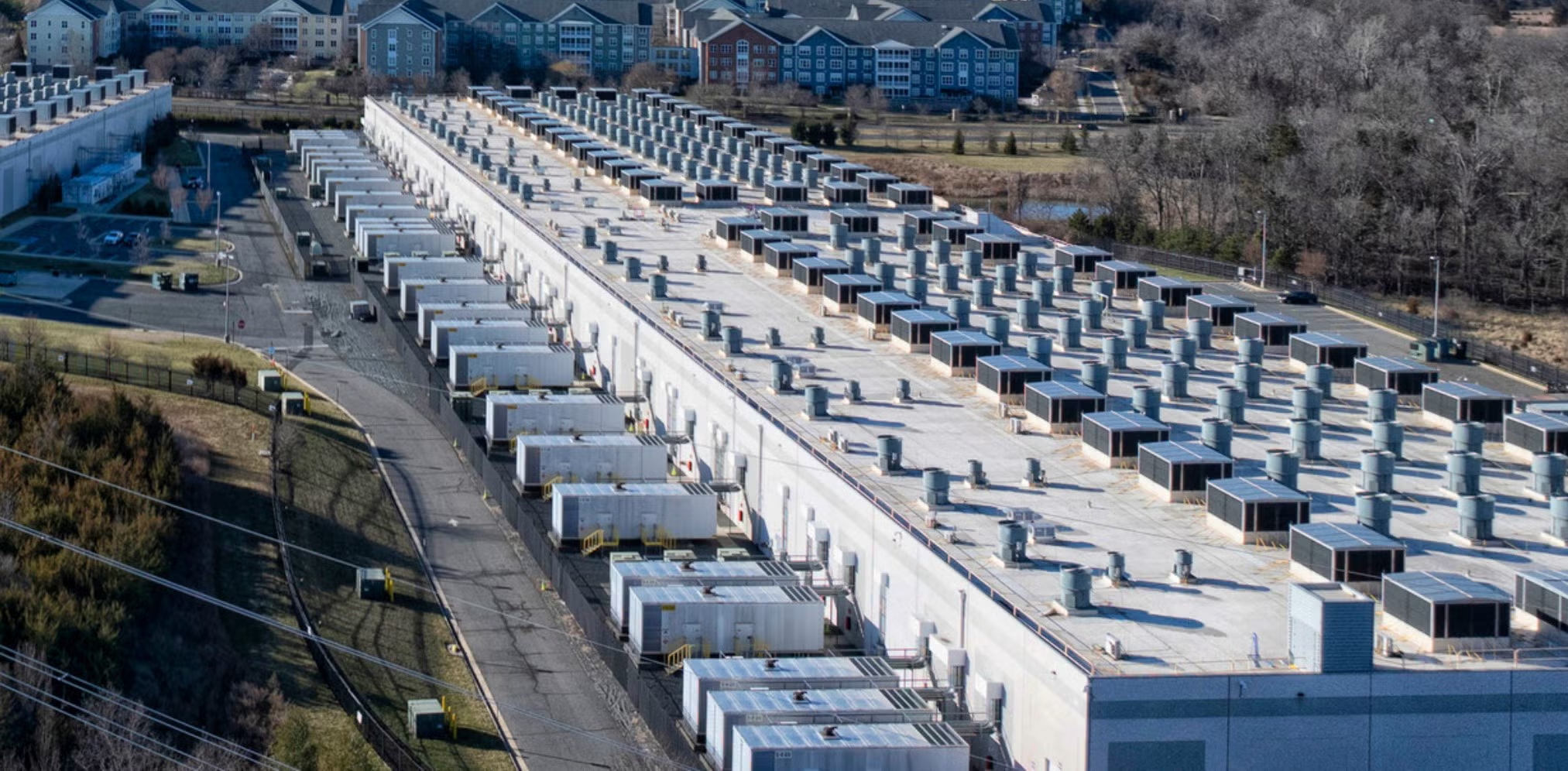
A new report shows that 75% of Americans are now opposing the new development of data centers local to where they live.
The study, conducted by Embold Research, shows that roughly more than six in 10 Americans say they would oppose the development of new data centers.
Source: Heatmap Pro / Embold Research
Heatmap says, “The shift against the facilities is represented across age, gender, income, partisan ID, and the rural-urban divide.”
“Data centers are 43 points underwater with Republicans, 65 points underwater with independents, and 75 points underwater with Democrats.
Notably, local data centers are 63 points underwater with rural voters, a group that has skewed more Republican over the past decade. Urban and suburban voters are only a few points more supportive of the facilities.”
To dive deeper into why more and more Americans are opposing the development of new AI data centers, it’s important to understand what data centers are and what data centers do.
What Are Data Centers and What Do Data Centers Do?
What are data centers? What do data centers do?
A data center is a specialized building or facility that contains large numbers of computers called servers.
These servers store information, run applications, process data, and provide online services.
For example, when you use cloud storage, stream a movie, open a website, or use an AI service, much of the computing happens on servers located in data centers.
A typical data center contains servers for computing, storage systems for keeping data, networking equipment for connecting servers to the internet, cooling systems to prevent overheating, and backup power such as batteries and generators so services can continue during power failures.
You can think of a data center as a huge, highly secured home for computers. Instead of having one computer doing everything, thousands—or sometimes hundreds of thousands—of servers work together.
Companies such as Google, Amazon Web Services, and Microsoft Azure operate large data centers around the world to provide cloud computing and internet services.
Why Are More Americans Opposing Data Centers?
Americans are becoming more opposing of data centers for a myriad of reasons.
The biggest concerns are:
Electricity consumption Data centers can consume enormous amounts of electricity, especially AI-focused facilities. Residents worry they could increase demand on the electrical grid and potentially contribute to higher electricity costs or require new power infrastructure.
Water consumption How do data centers use water? Some data centers use water-based cooling. In drought-prone regions, people understandably question why a facility should consume significant amounts of water for computing.
Noise They’re not just quiet warehouses. Cooling systems, fans, chillers, and backup generators can operate continuously. Communities near proposed facilities sometimes complain about constant industrial noise.
Environmental impact If the electricity comes from fossil fuels, the facility indirectly creates substantial emissions. Even when powered by renewables, residents may object to the land and infrastructure required.
Huge land requirements A large facility can occupy hundreds of acres. Communities may prefer that land for housing, commercial development, agriculture, or open space.
Tax incentives This is a particularly controversial one. Governments sometimes offer companies tax breaks or other incentives to build data centers. Residents may ask: “We’re giving one of the world’s richest companies tax advantages—what are we actually getting in return?”
They don’t necessarily create tons of permanent jobs Construction can create a lot of employment, but once operational, a highly automated data center may require relatively few full-time workers compared with a factory or large distribution center occupying similar space.
Fear of infrastructure strain Communities may need new substations, transmission lines, roads, water infrastructure, or gas generation to support the facility. Residents can see that as socializing the infrastructure cost while a private company captures the profits.
However, there’s a massive economic argument on the other side.
Why do we need data centers? Data centers are becoming foundational infrastructure for:
AI
cloud computing
streaming
financial services
cybersecurity
enterprise software
scientific research
autonomous systems
telecommunications
And the demand is exploding because AI requires far more computing power than traditional internet services.
The opposition isn’t necessarily irrational, and the industry’s growth isn’t necessarily bad either.
It’s fundamentally a fight over who bears the costs and who captures the economic benefits.
And there’s an especially interesting Wall Street/investment angle here: data centers are becoming one of the biggest physical bottlenecks in the AI boom—power, land, chips, cooling, and grid capacity are all becoming valuable assets.
Frank Nez is an American entrepreneur, journalist, writer, and investor. Frank's work has been cited by SEC and Congressional reports. Franknez.com is a personal finance and market news publication, dedicated to publishing content on money, investing, entrepreneurship, and retail investor news.