More of Gen Z and Millennials are now choosing stocks over houses as their primary investment vehicle.
Investing in stocks has grown in popularity over the past few years, particularly thanks to investing apps such as Robinhood and other mobile easy-to-use financial tools.
When meme stocks took Wall Street by a storm, everyone and their grandmothers was buying stocks.
And according to new reports, the investing trend is only growing.
Much of this is due to the low cost-to-entry barrier in the stock market in contrast to buying a home.
Buying a home today requires a significantly higher down payment than decades ago thanks to soaring interest rates.
The truth is, buying a home scares most Gen Z and Millennials. Rising costs, maintenance, raising capital then the unload of significant cash, all attribute to this fear.
Fortune says, “Decades later, fulfilling the typical American Dream of a home with white picket fence dotting the front lawn has become all but unattainable, as home prices have soared 235% since January 2000.
As a result, many young people are going all in on the stock market, viewing their brokerage accounts as the new American Dream.”
It’s important to understand that this is just a temporary vehicle of course.
Gen Z and Millennials still want to own homes; they’re just looking at stock investing as the engine boosters that will help them get there.
“For younger adults who despair about ever being able to buy a home, investing in financial markets can be a great way to save until they can afford one,” Chen Zhao, the head of economics research at Redfin, told Fortune.
The Age of First Time Home Buyers Jumps Significantly
First time homebuyer news and data.
For the first time, Americans aren’t buying homes at the age of 28 anymore. The age of the first-time homebuyer has jumped from 28 in 1992 to 40 in 2025.
While it’s going to take longer for Gen Z and Millennials to become first time homebuyers, buying a home is still seen as a good investment.
More than two thirds of Americans say buying a home is still an important asset as it holds value, appreciating over time.
Nearly a third of Gen Z adults (31%) say they’ve postponed buying a home because of financial pressure, and 34% worry they may never be able to afford one at all, according to Northwestern Mutual’s 2026 Planning & Progress Study.
Financial pressures include income worries and being unable to keep up with rising economic costs.
Poor financial habits may also play a role in having the cushion for a down payment.
For example, Gen Z and Millennials spend over $400 a month on nonessential items, according to a Morning Consult report.
This discretionary spending outpaces Gen X ($250/month) and baby boomers (under $200/month).
According to a Motley Fool Money survey, younger adults are the most likely to admit to throwing money away regularly:
Millennials: 8% admit to wasting money daily, and 16% do so a few times a week.
Gen Z: 6% waste money daily, and 17% do so a few times a week.
By comparison, only 1% of baby boomers admit to wasting money daily.
Despite these spending habits, minimum wage is not enough to afford a home.
Across the United States, housing costs have grown much faster than low-wage pay for decades.
A full-time minimum wage worker cannot comfortably buy or rent a home in most major areas without facing severe money struggles.
In most cases, multiple families must live together to afford the mortgage.
But this has been the case for many decades as well.
It’s gotten to the point where more than half of Millennials also say they’re forced to choose between investing for their retirement and homeownership.
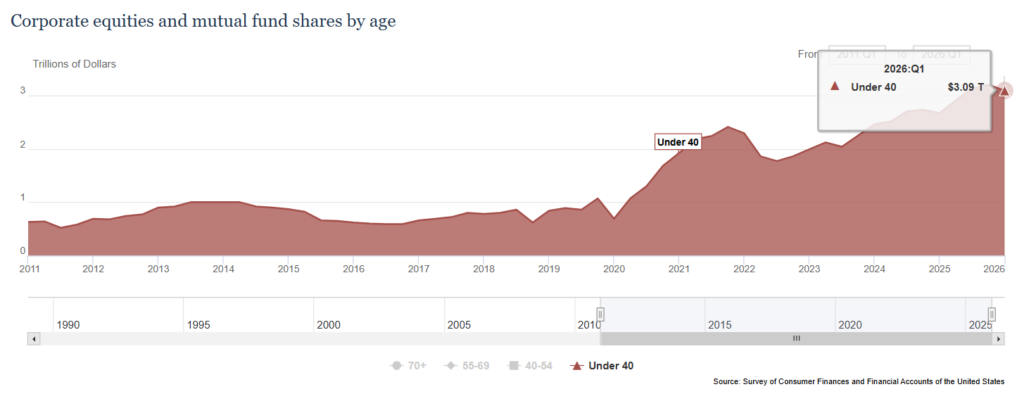
Young Americans Now Hold Stock Wealth Record
According to the Federal Reserve, a lot of the stock market now belongs to Americans under 40 since 1989.
Their combined holding has reached a whopping $3.09 trillion this year.
Source: Survey of Consumer Finances and Financial Accounts of the United States.
Financial analysis and market news publications such as FrankNez have also opened up opportunities for younger investors.
Over the years, younger investors have been able to capitalize on AMC’s short squeeze (2021), Bitcoin’s initial surge to $60K (2021), SHIB (2022), XRP (2024), Cardano (2024), all from momentum signals published on the publication.
As more and more Gen Z and Millennials begin to identify where to consume their research, more of their income will continue to flood the markets.
But what about the individuals that are able to afford buying a home?
Careers That Allow Gen Z and Millennials to Buy A Home
According to subreddit r/Adulting, Gen Z and millennial homeowners typically work in high-earning tech fields, specialized healthcare, finance, or the skilled trades.
Many young buyers achieve homeownership on household incomes between $100,000 and $125,000 by combining these salaries with side hustles, co-buying, or moving to affordable housing markets.
Top career choice for first time homebuyers include:
Tech and Engineering: Software developers, DevOps engineers, and tech sales professionals earn fast six-figure salaries that support modern mortgage approvals.
Skilled Trades: Electricians, HVAC technicians, plumbers, and aircraft mechanics command high wages with lower initial student debt.
Healthcare: Physician assistants, specialized nurses, and health technicians provide stable, high-demand incomes.
Finance and Real Estate: Financial analysts, accountants, and real estate agents leverage commission or market growth to build buying power.
Digital Content Creation: A growing niche of independent creators and entrepreneurs utilize multi-stream gig income to buy property.
However, career choices are only part of the equation. For example, younger buyers typically rely on:
Living with family or returning home post-college to aggressively save for down payments.
Purchasing smaller starter homes or fixer-uppers in mid-to-low cost-of-living areas.
Co-buying properties with romantic partners, family members, or friends.
Utilizing FHA loans and state-backed first-time buyer assistance grants.
For the first time homebuyer, it will be a matter of what type of lifestyle they are willing to sacrifice for now, or wait for later.
But I’m curious to know what you think. Leave your thoughts below.
Frank Nez is an American entrepreneur, journalist, writer, and investor. Frank's work has been cited by SEC and Congressional reports. Franknez.com is a personal finance and market news publication, dedicated to publishing content on money, investing, entrepreneurship, and retail investor news.